

Thank you for Subscribing to Auto Business Outlook Weekly Brief


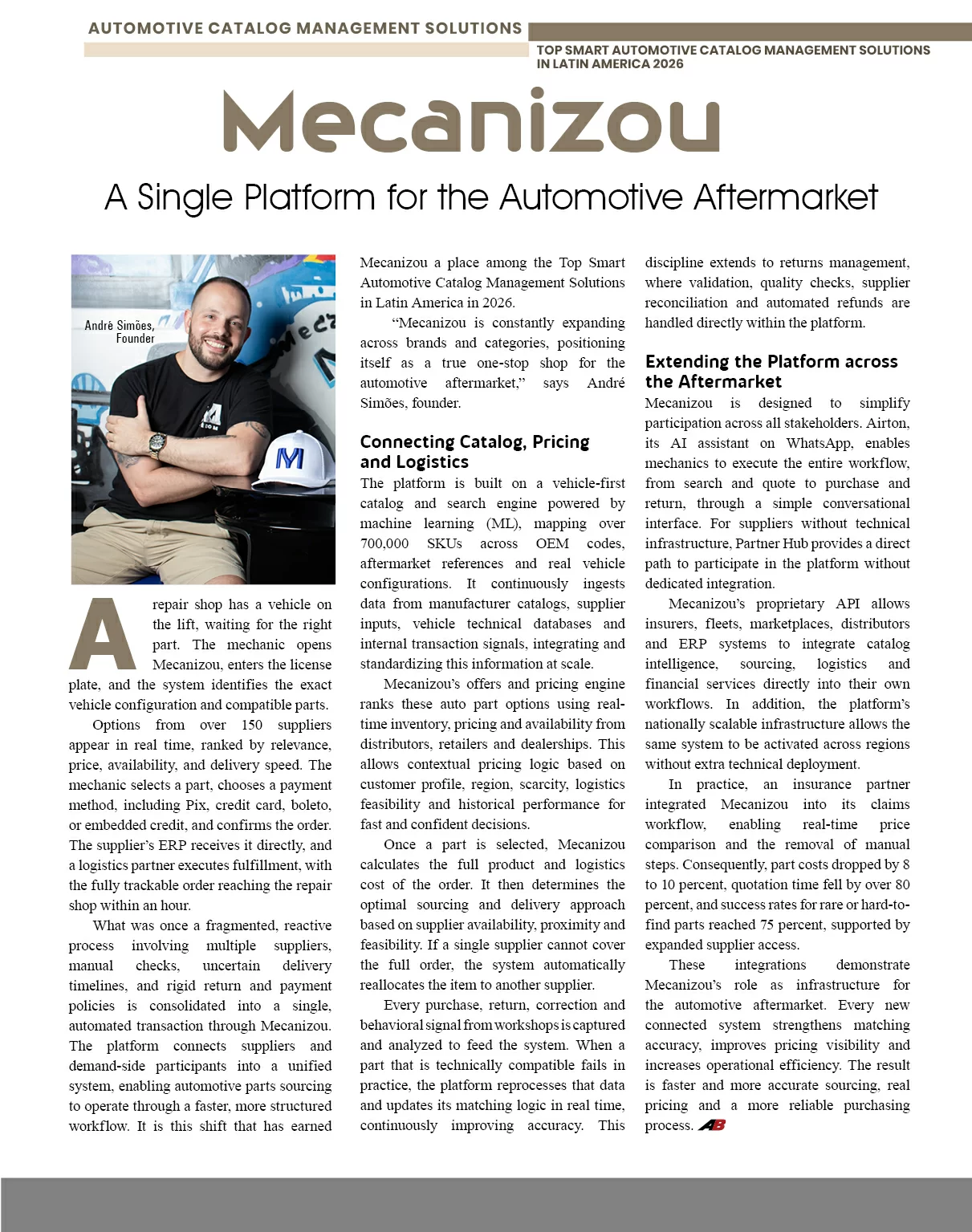
 André Simões, Founder
A repair shop has a vehicle on the lift, waiting for the right part. The mechanic opens Mecanizou, enters the license plate, and the system identifies the exact vehicle configuration and compatible parts.
Options from over 150 suppliers appear in real time, ranked by relevance, price, availability, and delivery speed. The mechanic selects a part, chooses a payment method, including Pix, credit card, boleto, or embedded credit, and confirms the order. The supplier’s ERP receives it directly, and a logistics partner executes fulfillment, with the fully trackable order reaching the repair shop within an hour.
What was once a fragmented, reactive process involving multiple suppliers, manual checks, uncertain delivery timelines, and rigid return and payment policies is consolidated into a single, automated transaction through Mecanizou. The platform connects suppliers and demand-side participants into a unified system, enabling automotive parts sourcing to operate through a faster, more structured workflow. It is this shift that has earned Mecanizou a place among the Top Smart Automotive Catalog Management Solutions in Latin America in 2026.
“Mecanizou is constantly expanding across brands and categories, positioning itself as a true one-stop shop for the automotive aftermarket,” says André Simões, founder.
Connecting Catalog, Pricing and Logistics
How does Mecanizou integrate catalog intelligence, pricing and logistics into one automotive platform?
The platform is built on a vehicle-first catalog and search engine powered by machine learning (ML), mapping over 700,000 SKUs across OEM codes, aftermarket references and real vehicle configurations. It continuously ingests data from manufacturer catalogs, supplier inputs, vehicle technical databases and internal transaction signals, integrating and standardizing this information at scale.
Mecanizou’s offers and pricing engine ranks these auto part options using real-time inventory, pricing and availability from distributors, retailers and dealerships. This allows contextual pricing logic based on customer profile, region, scarcity, logistics feasibility and historical performance for fast and confident decisions.
Mecanizou is constantly expanding across brands and categories, positioning itself as a true one-stop shop for the automotive aftermarket.
Once a part is selected, Mecanizou calculates the full product and logistics cost of the order. It then determines the optimal sourcing and delivery approach based on supplier availability, proximity and feasibility. If a single supplier cannot cover the full order, the system automatically reallocates the item to another supplier.
Why is continuous transaction feedback important for improving automotive parts matching accuracy over time?
Every purchase, return, correction and behavioral signal from workshops is captured and analyzed to feed the system. When a part that is technically compatible fails in practice, the platform reprocesses that data and updates its matching logic in real time, continuously improving accuracy. This discipline extends to returns management, where validation, quality checks, supplier reconciliation and automated refunds are handled directly within the platform.
Extending the Platform across the Aftermarket
In what way does Mecanizou simplify participation across automotive aftermarket stakeholders and partners?
Mecanizou is designed to simplify participation across all stakeholders. Airton, its AI assistant on WhatsApp, enables mechanics to execute the entire workflow, from search and quote to purchase and return, through a simple conversational interface. For suppliers without technical infrastructure, Partner Hub provides a direct path to participate in the platform without dedicated integration.
Mecanizou’s proprietary API allows insurers, fleets, marketplaces, distributors and ERP systems to integrate catalog intelligence, sourcing, logistics and financial services directly into their own workflows. In addition, the platform’s nationally scalable infrastructure allows the same system to be activated across regions without extra technical deployment.
In practice, an insurance partner integrated Mecanizou into its claims workflow, enabling real-time price comparison and the removal of manual steps. Consequently, part costs dropped by 8 to 10 percent, quotation time fell by over 80 percent, and success rates for rare or hard-to-find parts reached 75 percent, supported by expanded supplier access.
These integrations demonstrate Mecanizou’s role as infrastructure for the automotive aftermarket. Every new connected system strengthens matching accuracy, improves pricing visibility and increases operational efficiency. The result is faster and more accurate sourcing, real pricing and a more reliable purchasing process.
Bringing Precision and Flow to Automotive Parts Sourcing
Automotive parts sourcing across Latin America remains defined by fragmentation, inconsistent data and time-intensive coordination between workshops, distributors and logistics providers. Repair environments often operate across multiple brands and systems, where identifying the correct part is not only technical but contextual, shaped by vehicle configuration, real-world fitment and supplier variability. This creates persistent inefficiencies in quoting accuracy, delivery reliability and cost control, forcing decision-makers to rely on manual validation and redundant supplier interactions.
The most effective solutions in this space do not attempt to optimize isolated steps such as catalog lookup or pricing visibility. They address the entire sourcing lifecycle as a connected system where identification, quotation, procurement and fulfillment operate as a continuous flow. Precision in parts identification emerges as a foundational requirement. Systems that anchor search around the vehicle rather than part codes reduce ambiguity and compress decision time. When compatibility is continuously refined through real transaction feedback rather than static catalog data, the sourcing process shifts from assumption-driven to evidence-driven, lowering mismatch rates and reducing downstream returns.
Equally critical is the ability to unify supply-side complexity into a single decision layer. Buyers evaluating advanced catalog management solutions increasingly prioritize platforms that aggregate inventory, pricing and availability across a distributed supplier base while applying contextual logic to rank options. This includes not only price comparison but also delivery feasibility, regional constraints and supplier reliability. The result is not simply a broader choice, but a structured narrowing of options that aligns with operational priorities such as turnaround time and cost predictability.
Execution continuity then becomes the differentiator between visibility and actual performance. Systems that integrate purchasing directly into supplier infrastructure and coordinate logistics dynamically are able to convert decisions into outcomes without manual intervention. Real-time routing, supplier reallocation when stock fails and consistent tracking across the delivery journey ensure that sourcing decisions hold under real conditions rather than breaking at execution. This continuity extends beyond the initial transaction into post-sale processes, where structured returns and feedback loops reinforce system accuracy over time rather than introducing additional friction.
What emerges is a shift from fragmented coordination to a self-reinforcing ecosystem where each transaction strengthens the next. Data captured during identification improves future matching, execution outcomes refine pricing logic and post-sale feedback enhances supplier performance. In markets characterized by supplier diversity and logistical variability, this closed-loop model creates a measurable advantage in speed, accuracy and cost alignment, allowing buyers to move from reactive sourcing to consistent, controlled procurement.
Mecanizou exemplifies this integrated approach through a platform that connects catalog intelligence, pricing aggregation, purchasing and logistics into a single execution layer. Its vehicle-first catalog normalizes OEM and aftermarket data while continuously refining compatibility through real workshop behavior, reducing uncertainty in part selection. The system extends into real-time offer generation by combining supplier inventory, contextual pricing and delivery considerations, allowing buyers to evaluate options with clarity and speed. Once a decision is made, procurement flows directly into supplier systems, while logistics orchestration enables rapid, trackable delivery. Embedded payments and credit further align purchasing capacity with transaction flow. This end-to-end continuity positions it as a strong choice for organizations seeking consistent sourcing accuracy, faster execution and scalable supply chain coordination.
...Read more
Smart Automotive Catalog Management Solutions Info
Q1
Why Is Mecanizou Recognized Among Top Smart Catalog Management Providers?
Mecanizou stands out because it simplifies one of the most frustrating parts of the automotive aftermarket: finding the right part quickly and accurately. Instead of relying on calls, manual stock checks and back-and-forth quotes, the platform starts with a vehicle’s license plate, identifies the exact configuration and shows compatible parts from more than 150 suppliers. Results are ranked by relevance, price, availability and delivery speed, making the buying process faster and more reliable. That practical approach is why Smart Automotive Catalog Management Solutions in Latin America closely reflects Mecanizou’s role in the market.
Q2
What Differentiates Mecanizou’s Vehicle-First Catalog?
Mecanizou’s catalog is designed to do more than hold product listings. The platform connects hundreds of thousands of SKUs with OEM codes, aftermarket references and real vehicle configurations, creating a more accurate fitment system. It continuously enriches this information through supplier data, manufacturer inputs and transaction activity. Combined with live pricing and inventory visibility, the catalog becomes an active sourcing engine rather than a static database. This is where Smart Automotive Catalog Management Solutions in Latin America becomes especially relevant because the system supports matching, quoting and purchasing in real time.
Q3
How Does Mecanizou Support Repair Shops?
For repair shops, Mecanizou MAX brings the entire buying process into one platform. Workshops can search for parts, compare offers, manage payments, access credit options and track deliveries without leaving the system. The platform connects more than 300 factory catalogs and over 1 million available offers while providing real-time delivery updates. Smart Automotive Catalog Management Solutions in Latin America matters here because Mecanizou combines deep catalog intelligence with everyday operational needs such as plate-based lookup, supplier flexibility and delivery visibility.
Q4
How Does Mecanizou Support Suppliers and Partners?
Mecanizou also gives suppliers and distributors a more connected way to manage operations. Through the Partner Area, businesses can integrate catalog and stock information, manage deliveries and returns and monitor sales performance. The platform supports integrations through Excel, FTP and APIs, allowing suppliers to connect directly into the ecosystem without rebuilding their workflows. Within Smart Automotive Catalog Management Solutions in Latin America, this partner model is important because supplier data feeds directly into pricing, availability and fulfillment across the purchasing journey.
Q5
What Role Does Technology and AI Play in Mecanizou’s Model?
Technology at Mecanizou is focused on helping workshops make faster decisions during the buying process. The company’s AI assistant, Airtinho, supports automatic parts quoting, natural-language conversations, order placement and negotiation through continuous support channels. Beyond AI, the platform also offers enterprise APIs that connect with ERPs, insurers, fleet systems, estimators and e-commerce operations. That is why Smart Automotive Catalog Management Solutions in Latin America goes beyond simple search functionality and connects catalog intelligence with purchasing workflows, WhatsApp communication and operational automation.
Q6
Why Is Mecanizou Relevant to Current Automotive Aftermarket Needs?
The automotive aftermarket often struggles because inventory data, fitment details, pricing and delivery timelines are spread across disconnected systems. Mecanizou addresses that problem by combining catalog intelligence, pricing, logistics, credit and AI into one infrastructure layer. Its broader goal is to make parts purchasing faster, more transparent and easier for repair shops and suppliers alike. Smart Automotive Catalog Management Solutions in Latin America captures that relevance because Mecanizou is building the operational backbone behind faster sourcing, safer purchasing decisions and more reliable delivery tracking.
